Conversational interfaces and older users: the real tension
Why asking for a task costs older users less than navigating to it, and why the same people are least likely to have tried an AI product.
About this article
Navigating an app charges the user for holding a goal in mind, recognising controls and hitting small targets, and all three get harder with age. Asking for the task by name removes most of that. The complication is Pew's finding that only 10 percent of US adults over 65 have used ChatGPT, so they will not arrive expecting one.
Teams building conversational features usually picture a young user in a hurry. The evidence points somewhere more interesting, and it contains a contradiction worth designing around rather than ignoring.
The first half is well established. Navigating a visual interface charges the user for several things at once, and most of those things get harder with age. The second half complicates it. The people who would gain most from asking instead of hunting are also the people least likely to have ever used an AI product, so they will not come looking for one.
The design consequences run through every decision in a conversation, and this post is about who those decisions land on hardest.
The population this concerns is not a niche and is growing fast. The World Health Organization counts 1 billion people aged 60 and over as of 2020, rising to 1.4 billion by 2030, at which point one person in six on Earth is in that group.
What a navigated task actually asks for#
Finding something in an app is not one skill. It is holding your goal in mind while you search, recognising which control corresponds to it, aiming at that control accurately, and remembering what you already told the app two screens ago.
Timothy Salthouse’s review of the cognitive-ageing literature, When does age-related cognitive decline begin?, published in Neurobiology of Aging in 2009, reports that some decline starts far earlier than the popular picture suggests: “Some aspects of age-related cognitive decline begin in healthy educated adults when they are in their 20s and 30s.” Processing speed shows the steepest fall, around a standard deviation between 18 and 60, with reasoning and episodic memory somewhat behind it. Accumulated knowledge runs the other way, rising until at least 60.
That split is the whole design lesson. What declines is the machinery for working out where something is. What holds up is knowing what you want. An interface that asks people to search is taxing the falling column; an interface that asks people to say what they want is drawing on the rising one.
Nielsen Norman Group’s research on older users adds the sensory layer. Lexie Kane’s 2019 summary draws on three rounds of testing with 123 participants aged 65 and over, across five countries and nearly two decades. It is qualitative work, and it does not report success-rate numbers, so treat it as observation rather than measurement. The observation that stuck: participants described the internet as unfriendly to people with bad eyesight.
Two WCAG 2.2 criteria name the same demands in normative language. Target Size (Minimum) sets a 24 by 24 CSS pixel floor and lists hand tremor and fine motor difficulty among its beneficiaries. Redundant Entry requires that information already supplied in a process not be demanded again, and its Understanding document names short-term memory difficulty and mental fatigue as the reason.
Typing, specifically#
The Aalto University study of 37,370 people typing on their own phones found a clear age gradient, and the per-decade figures are in Table 4 of the paper rather than on the project page. Mean entry rate runs 39.6 words a minute for participants aged 10 to 19, 32.2 in their thirties, 28.9 in their forties and 26.3 in their fifties, against 36.2 across everyone. The reader this post is about types at about two thirds the rate of the team building for them.
A team of thirty-somethings testing a form will find it mildly annoying. The same form, with the same number of fields, is a materially different object for a user twice their age, and no amount of internal dogfooding will surface that.
The contradiction#
Here is the part that should change what you build rather than just what you believe.
Pew Research Center’s survey of 5,123 US adults, fielded in late February and early March 2025, found that 34 percent had ever used ChatGPT. Broken out by age: 58 percent of under-30s, 41 percent of 30 to 49, 25 percent of 50 to 64, and 10 percent of those 65 and over.
Set that against device ownership. Pew’s mobile fact sheet, from fieldwork between February and June 2025, puts smartphone ownership at 97 percent for 18 to 29, 96 percent for 30 to 49, 90 percent for 50 to 64 and 78 percent for 65 and over.
So the older user is on the phone, in your app, and has almost certainly never typed into a chatbot on purpose. They have no mental model of what the thing can do, no expectation that natural phrasing will work, and no reason to assume a microphone button belongs to anything more capable than dictation.
This is an argument for the in-app agent over the general-purpose one, and it is a strong one. The app is already familiar. The tasks are already bounded. The agent does not have to introduce the entire category, only one capability inside a product the user trusts.
What that means for the interface#
Discovery has to be visual and specific. A suggestion that reads “Ask me anything” teaches nothing. Three suggestions naming real tasks in this app, in the user’s own vocabulary, teach the whole model in one glance.
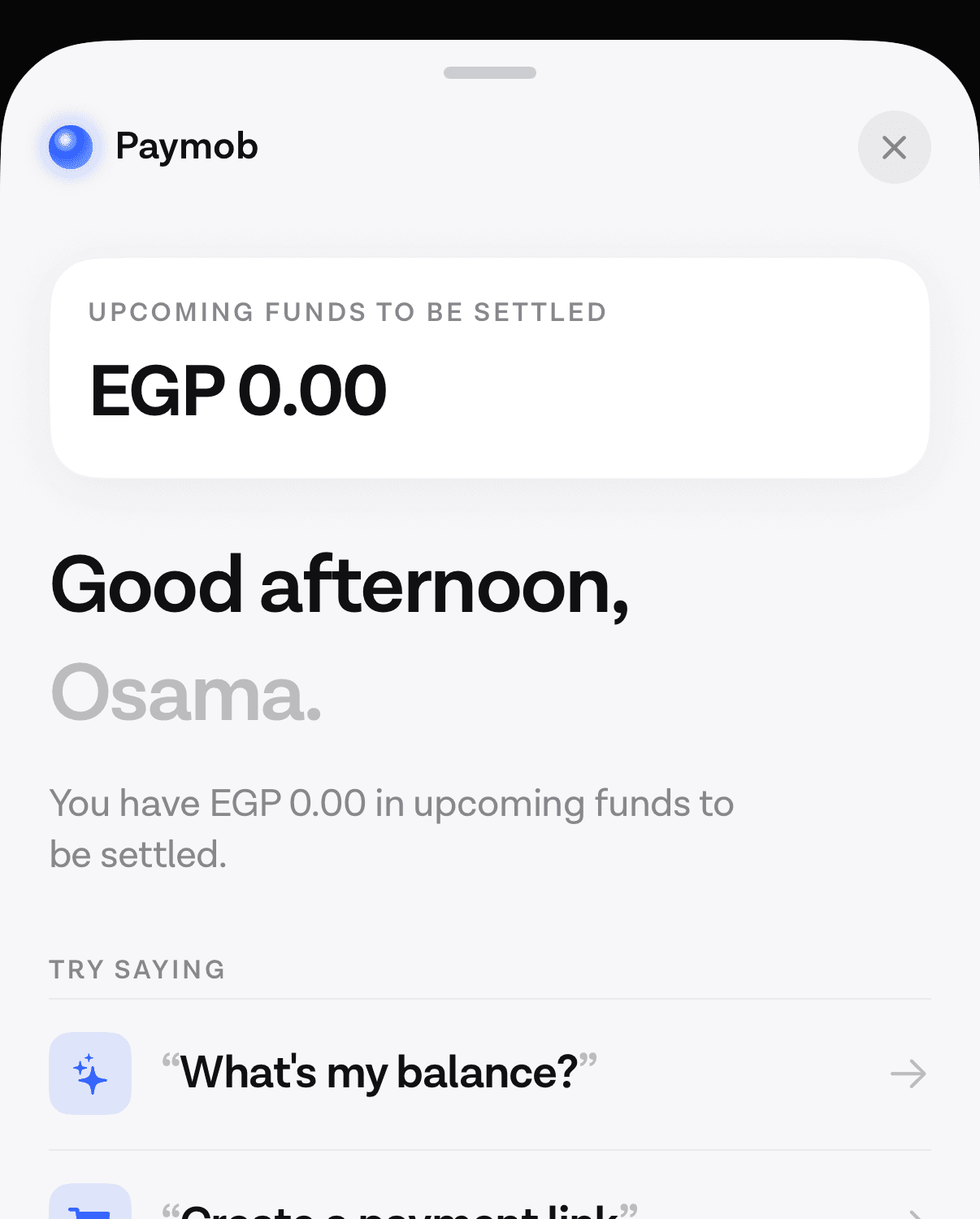
Keep the visual answer alongside the spoken one. An older user verifying a payment does not want to be told it cleared, they want to see the row. A conversational path that replaces the display rather than reaching it has removed the thing that made the app trustworthy.
Make text an equal input. Speech fails in a quiet waiting room, in a noisy one, with a speech impairment, and with any accent the model handles poorly. The same agent behind a text field costs nothing extra and removes all four failures.
And be honest about the failure mode that matters most here. When an agent misunderstands an older user, the user does not usually conclude that the agent is bad. They conclude that they did it wrong. For this audience, error recovery that restates the question in fewer words and offers a concrete option decides whether there is a second attempt at all.
What this does not show#
None of the above is evidence that older users prefer voice. It is evidence that the load an interface imposes falls unevenly, and that asking for a task by name avoids most of the load that rises with age.
Nor is age the interesting variable on its own. The demands above are the same ones that apply to a user with a hand tremor at 30, someone whose eyes are tired at the end of a shift, or anyone using one hand on a train. Age is the case where several of them arrive together, which is what makes it a useful design lens rather than a segment.
The related arguments are next door. The case for a spoken path as an alternative input route covers the curb-cut framing and the WCAG mechanics in full. What typing on a phone actually costs covers the input-speed evidence. When voice is the wrong mode is worth reading before assuming this argument generalises to every screen you own. The integration reference covers how the agent gets into the app.
Sources#
- Salthouse, T. A. When does age-related cognitive decline begin? Neurobiology of Aging, 30(4), 2009, 507 to 514. Accessed 12 September 2026.
- Kane, L. Usability for Seniors: Challenges and Changes, Nielsen Norman Group, 8 September 2019. Qualitative, 123 participants aged 65 and over. Accessed 12 September 2026.
- Palin, K., Feit, A., Kim, S., Kristensson, P. O., & Oulasvirta, A. How do People Type on Mobile Devices? MobileHCI ‘19. Accessed 12 September 2026.
- Pew Research Center. 34% of U.S. adults have used ChatGPT, 25 June 2025, n=5,123. Accessed 12 September 2026.
- Pew Research Center. Mobile Fact Sheet, fieldwork February to June 2025. Accessed 12 September 2026.
- W3C. Understanding SC 2.5.8: Target Size (Minimum), WCAG 2.2. Accessed 12 September 2026.
- W3C. Understanding SC 3.3.7: Redundant Entry, WCAG 2.2. Accessed 12 September 2026.
- World Health Organization. Ageing and health, 1 October 2025. Accessed 12 September 2026.
Next
The reference for what this post describes.
Read the docsThe rest of Voice
Open the clusterLatency budgets, barge-in, turn-taking and the parts of a voice pipeline that are somebody else's server rather than your code.
- Designing an agent conversation people can actually useThe seven decisions that make or break a conversational feature: discoverability, endpointing, barge-in, errors, confirmation, latency and the visual answer.11 min
- Voice is an alternative input path, not a speed featureThe case for a spoken path into your app, argued from the curb-cut effect, WCAG 2.2 and what screen reader users actually report.7 min
- How fast does a voice agent have to be? A latency playbookWhere a spoken turn's milliseconds go, what the turn-taking research actually measured, and which tactics shorten which segment of the budget.9 min
- What barge-in really costs, and how we pay for itServer-side turn detection decides when an agent should stop talking. The client decides whether it actually does, and that is where it breaks.11 min
- An in-app agent is an accessibility feature, narrowlyAn agent that completes a task is an alternative input path, and one WCAG 2.2 criterion turns the biometric confirm into an accessibility win rather than a tax.10 min
Elsewhere on the map
- Voice or chat: picking the mode for the taskSpeaking and typing are two inputs to the same agent. The situation the user is in decides which one wins, and four of those situations are predictable.Agent basics9 min
- Agent runtimes for mobile apps: an honest comparison (2026)OpenAI Realtime, LiveKit, ElevenLabs, Vapi and Retell compared on what a mobile team actually chooses between: layer coverage, client SDKs and the write path.Business8 min
- How to evaluate dialect coverage in a speech stackA vendor language list is a claim about a corpus, not about your users. The method for measuring what a speech model does on the varieties they actually speak.Language9 min