
Shipping UI without a release: the case for server-driven UI
Why mobile teams move layout decisions to the server, what it costs in versioning and coupling, and what changes when an agent is the thing choosing the shape.
About this article
Server-driven UI moves the choice of what appears on screen from the app binary to the server response, so a change reaches users who installed the app a year ago without a release. Thoughtworks rates it Trial as of April 2026. The costs are real: schema versioning for old clients, tighter client-server coupling, and changes that skip the release train's regression testing.
There is a question every mobile team eventually asks out loud: why does changing one screen require shipping a new binary to everyone. Server-driven UI is the answer that has been circling that question for a decade, and it has finally arrived at the ring where it is taken seriously.
Thoughtworks placed it at Trial in Volume 34 of the Technology Radar (April 2026), with the mechanism stated cleanly: by separating rendering into a generic container while providing structure and data from the server, “mobile teams can bypass lengthy app store review cycles for every iteration.” The same entry warns against a god-protocol and recommends applying it to highly dynamic areas rather than as a blanket replacement.
This post is the why. The how, for an agent specifically, is why an agent should draw product UI at all.
Where the delay actually sits#
App review is fast now compared to a decade ago, and it is not what makes shipping a screen slow. What makes it slow is your own release train, and then the long tail of people who do not update.
Kevin Fang of Lyft put a number on that tail in a MobileNativeFoundation discussion on server-driven UI: “We officially support rider/consumer clients up to 2 years old and have limited control over whether users ever update their apps.” Two years is the horizon that matters. A change that lives in the binary is invisible to a meaningful share of your users for a year or more, and there is nothing your roadmap can do about it.
Ryan Briones of Airbnb named the flip side in the same thread: “Depending on the SDUI system, it’s common to be able to launch features back to previous releases with no client code changes needed assuming the response is supported.”
That is the whole business case in two quotes from two people who ran it at scale.
The schema is the real contract#
Moving the decision to the server does not remove the compatibility problem. It relocates it from the code to the payload, where it is easier to get wrong because nothing fails at compile time.
The rule that follows is unglamorous and load-bearing: every shape needs a defined fallback, decided before the shape ships. A client that receives a widget kind it has never heard of must render something sensible rather than nothing, and “sensible” has to be specified by whoever adds the kind.
Fang is blunt about the coupling this creates. The downsides he lists include “tight coupling between client and server, which makes it hard to change client or server independently”, and the observation that “some changes that are easy to make when all of the logic lives on the client become harder when the logic moves to the server.”
What it costs, on both sides of the ledger#
Four costs are worth stating before anyone builds this.
The build itself pays nothing back while it is happening. Fang again: “Server-driven client platforms are resource-intensive to build, and the initial investment phase often yields no business benefit.”
Changes that skip the release train also skip its safety net. “Features released under server-driven client platforms are independent of the client release train, and thus by default are not subject to the same level of stability and regression testing.” A bad response reaches everyone at once, which is the same property that makes the approach valuable.
The schema grows. Every product team that wants one more knob adds one more field, and the thing that started as five shapes becomes a layout language nobody can change safely. This is the god-protocol Thoughtworks warns about, and avoiding it is a matter of saying no rather than of architecture.
And the layer can be abandoned. Spotify’s Hub Framework, once the reference implementation for this pattern, carries a plain notice in its README: “The Hub Framework is being phased out at Spotify, and therefore we will not be maintaining it further.” The repository was archived on 17 January 2019. Building your own means signing up to maintain a platform, and platforms have a mortality rate.
Four rules that keep the schema small#
Add a shape only when an existing one genuinely cannot carry the answer. Most requests for a new widget kind are requests for a variant of one you already have, and a variant is a field rather than a kind.
Give every shape a fallback at the moment you define it, in the same pull request. A fallback decided later is a fallback decided after a client has already shipped without one.
Version the shape, not the payload. A client can be told it is looking at version two of a list and decide whether it understands that; a globally versioned payload forces a branch on the server for every generation in the wild.
Log what old clients could not draw. That number is the only honest measure of how much of your audience your new shape is actually reaching, and without it you will assume the answer is everyone.
What changes when an agent is choosing#
Classic server-driven UI answers a question the product team already asked. A merchandiser decides the home screen should show a carousel this week, and the server says so.
An agent changes who is asking. The user says something nobody anticipated, and the shape of the correct answer is decided at that moment: a single figure, a list of twelve rows, a chart, a confirmation. Nobody can enumerate those combinations in advance, which is exactly the condition under which moving the decision to the server stops being an optimisation and becomes the only way the feature works at all.
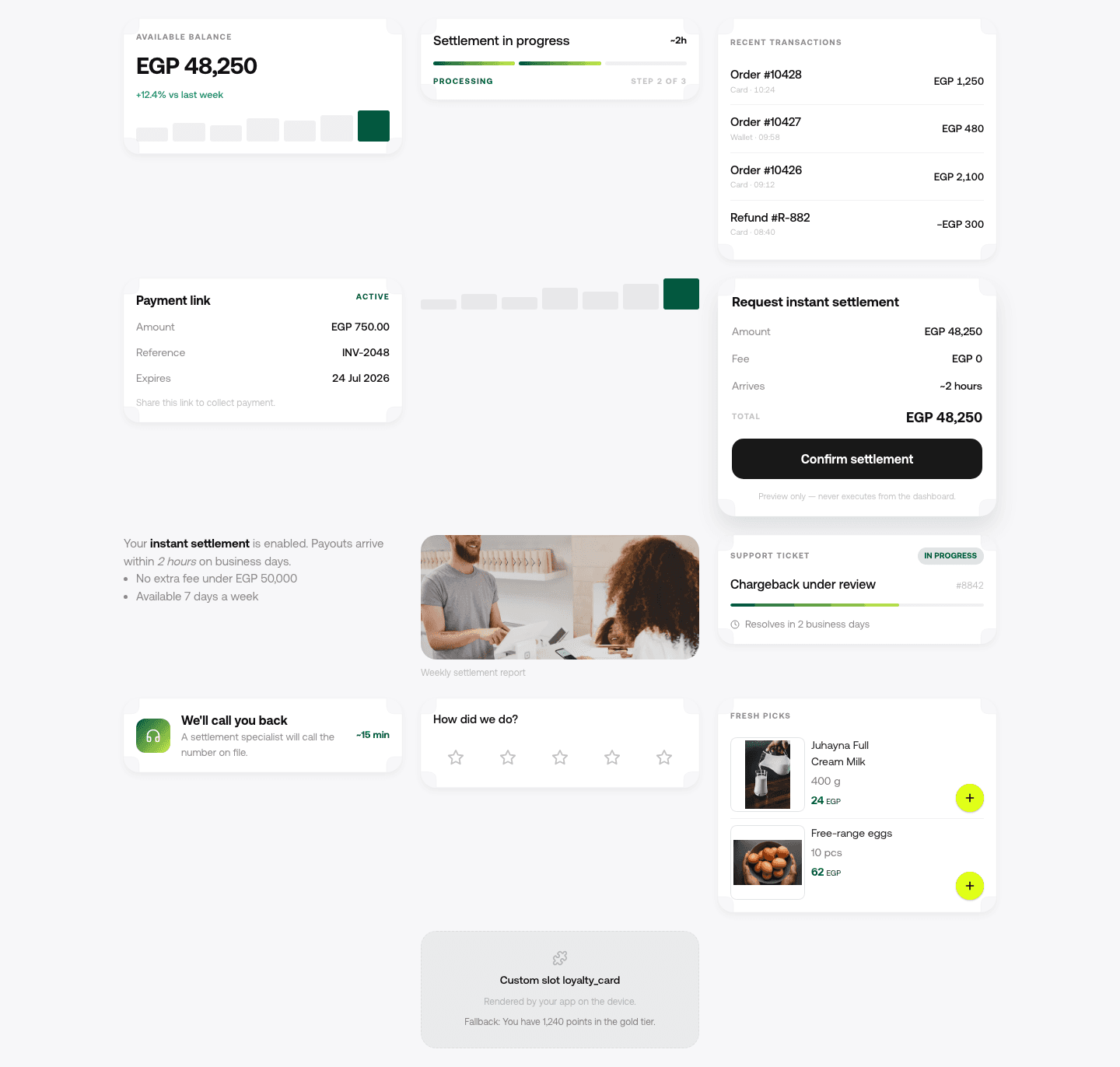
The set stays closed for a reason beyond tidiness. An agent that can emit arbitrary layout can be persuaded by content it read from your backend to draw something that looks like your approval screen. A fixed vocabulary removes that class of attack, and it keeps the fallback problem tractable, because the number of shapes an old client might not know is small and countable.
How to tell whether you need this yet#
Three signals say the investment will pay back, and none of them is “the architecture is elegant”.
Your release train is the reason a change waits. If a one-line copy fix or a reordered card sits in a queue for three weeks, and that happens often, the cost of the queue is already being paid in something other than engineering time.
A meaningful share of your users are on old binaries. Pull the version distribution from your analytics. If the ninetieth percentile is more than six months behind, a change shipped in the binary is invisible to a large group for a long time, and you can put a number on that group rather than guessing.
The surface changes for reasons outside the code. A feed, a promotional slot, a results list or an agent’s answers all change because data changed, not because someone shipped a feature. Those are the areas where the server already knows more than the binary does.
If none of the three is true, the schema and the versioning discipline will cost more than they return. Ship the screens in the binary and revisit it when one of them becomes true.
Where to start, and where not to#
Apply it where the content genuinely changes without a code change: a home feed, a promotional surface, a results list, an agent’s answers. Those are the areas Thoughtworks means by “highly dynamic”.
Leave it out of the parts of your app whose layout is stable and whose interactions are already well understood. A settings screen does not need to be a payload. Neither does a checkout form that has looked the same for three years.
The version of this that ships fastest is the narrow one. A closed set of shapes with defined fallbacks, covering one surface, is a week of work and can be extended. A general layout language is a platform, and you have just read what happened to one of those. The architecture it sits inside and the decade of mobile practice behind it are the two posts to read next.
Sources#
- Thoughtworks, Technology Radar: server-driven UI, Volume 34, April 2026. Accessed 12 September 2026.
- MobileNativeFoundation, Server-driven UI discussion #47, with contributions from Kevin Fang (Lyft) and Ryan Briones (Airbnb). Accessed 12 September 2026.
- Spotify, HubFramework README, repository archived 17 January 2019. Accessed 12 September 2026.
Next
The catalogue of every widget kind the agent can ask your app to draw, and the payload each one takes.
See the widget catalogueThe rest of Render spec
Open the clusterServer-driven native UI: the agent names the widgets, your app draws them, and shipping a new answer shape stops requiring an app release.
- Generative UI on native mobile: how an agent draws real product UIGenerative UI on the web streams React components. On iOS and Android it has to become a typed spec over a fixed native catalogue. Here is why, and how it works.15 min
- In-app search when the query is a whole sentenceHow search inside an app breaks when people speak in sentences, and how to build the search tool an agent can actually call.7 min
- How a render spec turns one JSON payload into native UIThe whole contract is a spoken answer, a separator, and an array of widget objects. The interesting parts are the constraints, not the format.10 min
- The first 300 milliseconds of an agent turnYou cannot make the model faster from the client. Almost all of the felt wait is decided before the model has said anything, and that part is yours.10 min
- Server-driven UI was already the answer. LLMs made it urgent.Server-driven UI and generative UI are one idea arriving from two directions, and a decade of mobile practice already tells you which parts are hard.10 min
- A catalogue beats free-form generation, and the objections say whyEvery serious objection to generative UI is an objection to free-form generation. A fixed catalogue answers all four without giving up the idea.10 min
Elsewhere on the map
- How to add an AI agent to a mobile app: the complete guideWhat an in-app agent is made of, what each of its five pieces costs to own, and the honest path from a first spoken turn to something you can hand to users.Business12 min
- Adding an AI agent to a Flutter app, and what GenUI gives youThe platform-channel integration, and an honest comparison with Flutter's own GenUI SDK: what the alpha covers, what production needs, and which to pick.Integration8 min
- In-app agents that finish the task instead of answeringAn assistant that describes where a setting lives competes with your own navigation. One that completes the request does not. What changed, and what to build.Agent basics8 min